
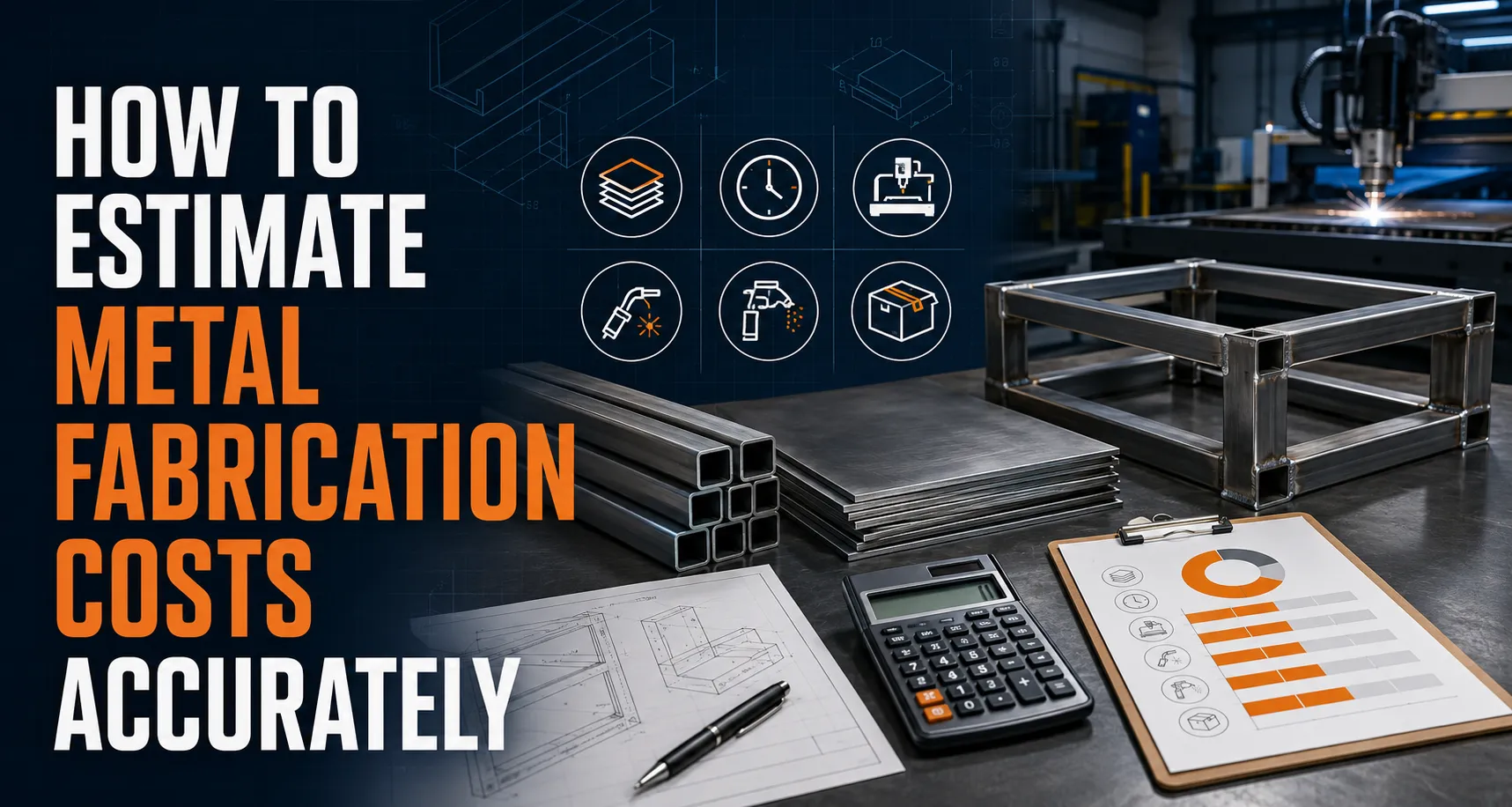
An accurate fabrication estimate must do more than add the price of steel to a few hours of welding. Every job consumes material, machine capacity, labour, consumables, handling, inspection and business overhead. A quotation that misses these elements can look competitive while quietly losing money.
The purpose of estimating is not to predict every minute perfectly. It is to build a consistent, evidence-based view of the work, include uncertainty and create a price that supports both the customer’s requirements and a sustainable workshop.
Confirm the Scope Before Pricing
Start with a complete scope. Review:
- drawings and 3D models;
- quantity;
- material grade and thickness;
- dimensional and welding requirements;
- surface finish;
- delivery date;
- inspection or certification;
- packaging;
- installation; and
- exclusions.
Identify missing information before calculating costs. A vague request for a “stainless table” can describe anything from a basic workshop stand to a hygienic food-processing assembly with polished welds and documented traceability.
State assumptions in the quote. If the estimate assumes customer-supplied drawings, uncoated mild steel or collection from the workshop, say so.
Break the Job into Operations
Create a routing that follows the real production sequence. A typical sheet-metal job may require:
- material receipt and identification;
- CNC programming and nesting;
- laser or plasma cutting;
- deburring;
- bending;
- machining;
- fit-up and welding;
- grinding and finishing;
- coating;
- inspection;
- assembly; and
- packing and delivery.
Breaking the work into operations reduces the chance of forgetting a step. It also makes the estimate easier to compare with actual production later.
Calculate Material Cost Correctly
Material cost includes more than the net weight of finished parts. Account for:
- supplier price;
- minimum order quantity;
- sheet or stock size;
- cutting yield;
- saw or cutting kerf;
- edge trim;
- unusable remnants;
- certificates;
- freight; and
- price volatility or quote validity.
For sheet parts, use a realistic nest rather than dividing part area by sheet area. Part shape, spacing, grain direction and mixed quantities affect yield. For profiles, optimize lengths while allowing for kerf, end trim and damaged ends.
Reusable remnants have value only if they are identified, stored and likely to be used. Do not credit every offcut as if it were cash.
Separate Setup Time from Run Time
Setup costs occur even when only one part is made. They may include:
- reviewing files;
- programming;
- loading material;
- changing tooling;
- setting machine parameters;
- preparing fixtures;
- first-article inspection; and
- cleaning equipment.
Run time increases with quantity. Separating the two explains why the unit price generally decreases in a larger batch.
For example, a press-brake job may require thirty minutes to select tools, load the program and verify the first component, then only a short cycle for each additional part. Combining everything into one guessed hourly figure makes quantity pricing unreliable.
Estimate Cutting Time
CNC cutting cost depends on more than total contour length. Consider:
- material and thickness;
- pierce count;
- internal holes;
- cut speed;
- rapid movement;
- consumables;
- assist gas;
- loading and unloading;
- part sorting; and
- deburring.
Many small holes can cost more than one long outer profile because every pierce adds time and consumable wear. Thick plate, difficult alloys and high-quality edge requirements also influence the process.
Use machine software or historical data where possible. Confirm that the chosen process can meet the required tolerance and edge quality before using its lower rate.
Estimate Bending Operations
Count the bends, but also examine their difficulty. Cost drivers include:
- tool changes;
- unusual bend radii;
- long or heavy parts;
- multiple setups;
- tight return flanges;
- staged forming;
- hemming;
- operator assistance; and
- inspection between bends.
A small box with six bends may take longer than a large channel with two simple bends. Part handling and sequence matter.
Use shop-proven bend data. If a new design requires special tooling, include purchase, rental or manufacture of that tooling.
Estimate Fit-Up and Welding
Welding time includes preparation and handling, not only arc-on time. Account for:
- edge preparation;
- cleaning;
- fixture setup;
- alignment and clamping;
- tack welding;
- preheat where specified;
- welding position;
- number of passes;
- interpass cleaning;
- distortion control;
- repositioning;
- visual inspection; and
- repair risk.
Joint accessibility can dominate cost. A short weld inside a narrow enclosure may be slower than a longer joint positioned flat on a bench.
Do not reduce required weld length or size to meet a price target. Structural and safety-critical work must follow the approved drawing, welding procedure and applicable code.
Include Grinding and Finishing
Finishing is frequently underestimated. “Grind smooth” may require substantial labour, especially where welds must disappear into visible stainless or painted surfaces.
Clarify the finish standard:
- as-welded;
- spatter removed;
- weld blended;
- directional brushed finish;
- polished finish;
- painted;
- powder coated;
- galvanized; or
- passivated or chemically treated.
Include abrasives, discs, belts, polishing compounds and tool wear. For subcontract coating, add transport, packaging and vendor lead time as well as the supplier price.
Price Bought-In Components and Hardware
List fasteners, hinges, wheels, handles, latches, seals, timber inserts and other components individually. Include:
- unit cost;
- minimum pack quantity;
- freight;
- installation time; and
- expected waste or spares.
Small hardware lines can become significant across a production batch. They also create schedule risk if the item has a long lead time.
Apply Labour and Machine Rates Consistently
An hourly rate should reflect the cost of providing that resource. Depending on the business, it may include wages, benefits, utilities, maintenance, depreciation, floor space and supervision.
Different operations may need different rates. A CNC laser, manual welding bay and simple assembly bench do not carry the same cost. Use rates that match the actual resource rather than applying one arbitrary figure to every hour.
Avoid confusing labour cost with selling price. The final price must also contribute to overhead and profit.
Add Overhead
Overhead covers costs that cannot be assigned neatly to one product, such as:
- rent;
- administration;
- software;
- insurance;
- calibration;
- quality systems;
- sales;
- non-productive supervision; and
- general workshop utilities.
Businesses allocate overhead in different ways: as a percentage, an hourly burden, a machine rate or activity-based charges. The method matters less than applying it consistently and checking whether it recovers real costs.
Allow for Risk and Uncertainty
New designs, unclear drawings, difficult tolerances and short delivery dates carry more risk than repeat work. Add a visible contingency or adjust the estimate based on evidence.
Common risks include:
- unproven forming operations;
- unknown weld access;
- distortion-sensitive assemblies;
- volatile material prices;
- customer design changes;
- subcontractor delays;
- rework exposure; and
- incomplete specifications.
Do not hide unlimited risk inside a fixed price. State the validity period, revision basis and change-order process.
Add Profit Deliberately
Profit is not the amount accidentally left after paying costs. It funds investment, absorbs business risk and supports future capacity.
Apply margin deliberately and understand the difference between markup and margin. A 20 percent markup on cost does not create a 20 percent gross margin on selling price. Use the method adopted by the business and calculate it correctly.
Price is also influenced by value, market conditions, capacity and delivery urgency, but those factors should be considered after the cost foundation is sound.
Compare Estimate with Actual Results
The best estimating system learns from completed jobs. Record actual:
- material consumed;
- setup and run times;
- consumables;
- subcontract costs;
- scrap;
- rework; and
- delivery cost.
Compare these with the estimate and investigate major differences. If bending consistently takes 30 percent longer than quoted, determine whether the standard time, routing detail or production method is wrong.
Historical data is especially valuable for repeat product families.
Fabrication Estimate Checklist
Before issuing a quotation, confirm that it includes:
- a defined drawing revision and quantity;
- material grade, size and realistic yield;
- cutting setup, machine time and consumables;
- bending operations and tooling;
- fit-up, fixtures and welding;
- grinding and finish level;
- purchased hardware;
- inspection and documentation;
- packaging and transport;
- subcontract work;
- overhead;
- risk allowance;
- profit; and
- clear assumptions, exclusions and validity.
Final Thoughts
Reliable fabrication pricing comes from a repeatable process. Define the scope, build a manufacturing route and calculate each cost driver using current supplier information and shop data. Then add overhead, risk and profit consciously.
After production, compare the estimate with reality. This feedback turns quotations from educated guesses into a growing body of manufacturing knowledge—and helps the workshop win the right work at a sustainable price.

 No products in the cart.