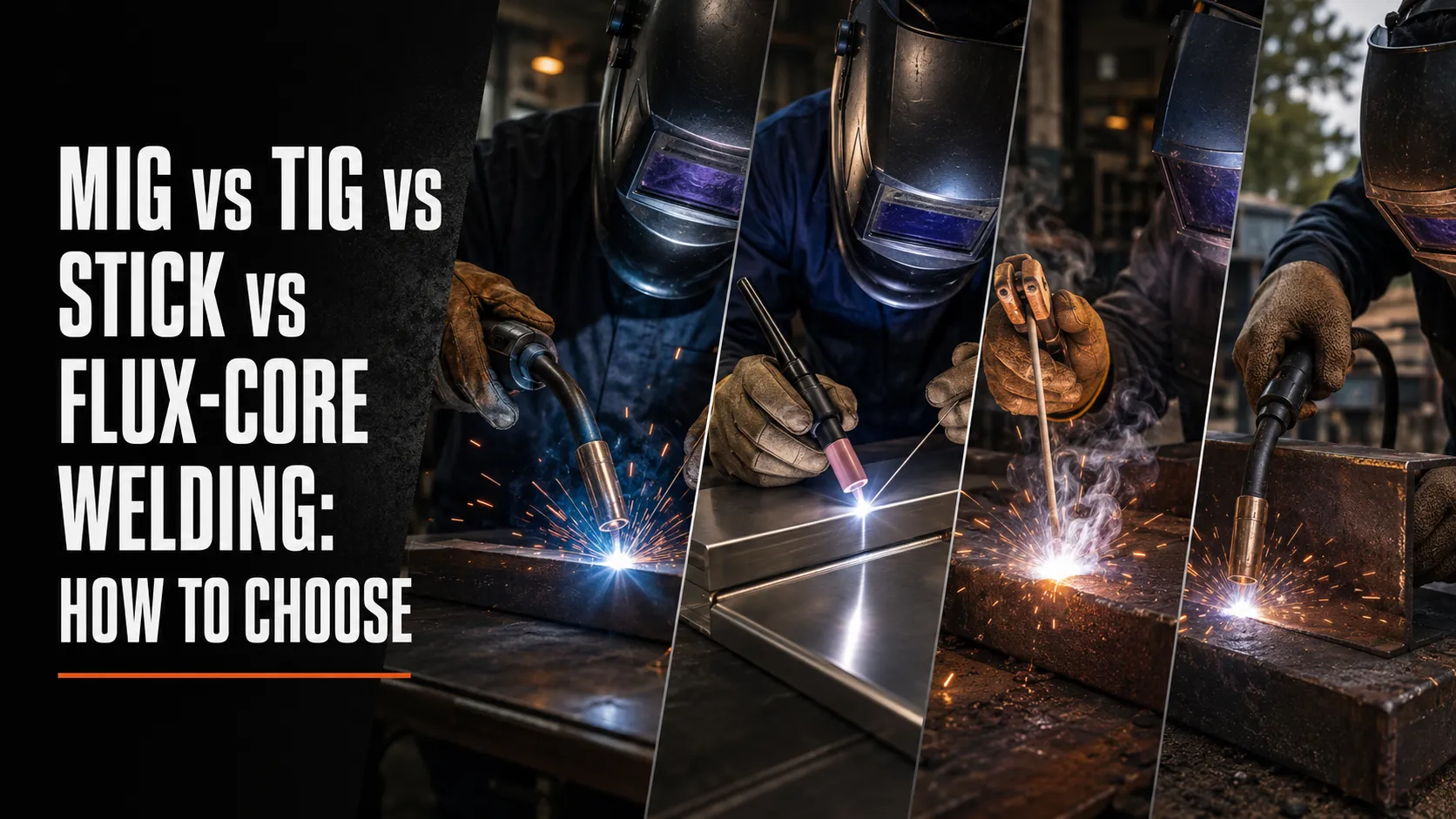
No single welding process is best for every job. A process that produces beautiful stainless-steel work in a clean workshop may be slow and impractical on an outdoor structural repair. A fast production process may introduce too much heat into a thin decorative panel. The right choice depends on the metal, thickness, joint, position, environment, quality requirement and available equipment.
This guide compares MIG, TIG, stick and flux-core welding so small and medium workshops can make a sensible selection before production begins.
Start With the Job, Not the Machine
Workshops often choose a process because it is the machine already connected. That may be convenient, but it can create excessive cleanup, slow production or poor weld quality.
Before selecting a process, define:
- base-metal type and grade;
- minimum and maximum thickness;
- joint type and access;
- welding position;
- indoor or outdoor location;
- required appearance;
- required deposition rate;
- applicable welding code or procedure;
- available power and shielding gas; and
- operator qualifications.
For structural, pressure, lifting or safety-critical work, the approved welding procedure specification decides the permitted process and essential variables.
MIG Welding: Fast and Accessible
MIG is the common workshop name for gas metal arc welding, or GMAW. A motor feeds a continuous wire electrode through the welding gun while shielding gas protects the molten weld pool.
Advantages of MIG
- High productivity because wire feeds continuously
- Easy arc starting and relatively short learning curve
- Little slag to remove
- Good suitability for repetitive fabrication
- Capable of welding steel, stainless steel and aluminium with the correct setup
- Convenient for thin to medium sections
Limitations of MIG
- External shielding gas is vulnerable to wind
- Surface contamination can cause porosity and fusion problems
- Wire feed, liner, contact tip and gas system add setup variables
- Access can be limited by gun size
- Incorrect transfer mode or settings can cause lack of fusion
MIG is a strong choice for workshop furniture, frames, cabinets, automotive work and production assemblies made from clean material. It performs best when parts have consistent fit-up and the work area is protected from drafts.
TIG Welding: Precise and Clean
TIG, or gas tungsten arc welding, uses a non-consumable tungsten electrode. Filler metal is added separately when required, and inert shielding gas protects the weld.
Advantages of TIG
- Excellent control of heat and filler addition
- Clean welds with no slag
- Precise work on thin material
- High-quality appearance
- Suitable for many metals, including stainless steel and aluminium
- Useful for pipe roots, sanitary work and detailed components
Limitations of TIG
- Slower deposition than wire-fed processes
- Greater coordination and skill required
- Joint cleanliness is critical
- Shielding is sensitive to drafts
- Equipment and preparation can be more demanding
TIG is often selected for stainless handrails, food-service equipment, aluminium components, visible architectural work and thin sheet where appearance and control are more important than maximum production speed.
Miller notes that DC-only TIG equipment is suitable for steel and stainless, while conventional TIG welding of aluminium normally requires AC capability; see its TIG welding basics.
Stick Welding: Robust and Portable
Stick welding, or shielded metal arc welding, uses a flux-coated consumable electrode. The flux produces shielding gas and slag as the electrode melts.
Advantages of Stick
- Portable and relatively simple equipment
- Performs well outdoors
- No external shielding-gas cylinder required
- Useful on heavy sections and site repairs
- Wide range of electrode classifications
- Can tolerate less-than-perfect field conditions better than many gas-shielded processes
Limitations of Stick
- Slag must be removed between passes
- Electrode changes interrupt production
- More difficult on very thin sheet
- Greater risk of starts, stops and stub loss
- Electrode storage and moisture control are important
- More smoke and spatter than some alternatives
Stick is widely used for structural site work, equipment repair, agricultural fabrication and jobs where wind or access makes gas shielding difficult. It is not automatically suitable for dirty metal; removing rust, paint, oil and scale still improves results.
Flux-Core Welding: High Deposition and Field Capability
Flux-cored arc welding uses a tubular wire containing flux. Gas-shielded FCAW uses external shielding gas, while self-shielded FCAW-S relies on the wire’s flux system.
Advantages of Flux Core
- High deposition rate
- Strong performance on thicker material
- Good positional capability with the correct wire
- Self-shielded wires are practical outdoors
- Continuous wire feed improves productivity over stick
- Common in structural and heavy fabrication
Limitations of Flux Core
- Slag removal is required
- More fume and spatter than typical solid-wire MIG
- Wire classification and polarity must be followed exactly
- Gas-shielded versions remain sensitive to wind
- Thin sheet can be difficult because of heat input
Lincoln Electric describes gas-shielded flux core as a flexible process used across major industries and all-position applications. The exact wire, gas and procedure must match the job.
Quick Comparison
| Factor | MIG | TIG | Stick | Flux Core |
|---|---|---|---|---|
| Production speed | High | Low to medium | Medium | High |
| Thin sheet | Very good | Excellent | Limited | Limited to good |
| Thick material | Good | Possible but slow | Very good | Excellent |
| Outdoor use | Poor without protection | Poor without protection | Very good | Very good with self-shielded wire |
| Appearance | Good | Excellent | Functional | Functional to good |
| Slag removal | No | No | Yes | Yes |
| Portability | Medium | Medium | Excellent | Good |
| Skill demand | Beginner to intermediate | Intermediate to advanced | Intermediate | Intermediate |
This table is general guidance. Equipment, transfer mode, filler classification and welding procedure can change performance significantly.
Choose by Material
Carbon steel
All four processes can weld carbon steel. MIG suits clean production work, TIG suits thin or high-finish components, stick suits field work, and flux core suits higher-deposition structural fabrication.
Stainless steel
TIG offers excellent control and appearance, especially on thin sections. MIG can be productive with the correct stainless filler and shielding gas. Stick and flux core are available for heavier or field applications. Dedicated tools and heat control help preserve corrosion resistance.
Aluminium
TIG is common for thin, detailed work, while MIG with a spool gun or push-pull system is productive on thicker sections. Conventional stick and common flux-core processes are not the normal first choice for aluminium fabrication. Aluminium requires careful oxide removal, dry material and appropriate shielding.
Cast iron and special alloys
Process selection depends strongly on the specific grade, filler and thermal procedure. Do not select a process from appearance alone. Repair welding may require alloy identification, preheat and controlled cooling.
Choose by Work Environment
Gas-shielded MIG and TIG need protection from wind. Even a light draft can disturb shielding and introduce porosity. In outdoor work, create a safe wind barrier or use an approved stick or self-shielded flux-core procedure.
Confined spaces introduce ventilation, access and electrical hazards. OSHA identifies welding fumes, UV exposure, burns, shock and physical injuries among welding risks. Review applicable controls in the OSHA welding hazards guidance.
Choose by Production Goal
For repeat frames and brackets, MIG or flux core may reduce cycle time. For a visible stainless product, TIG may reduce post-weld finishing. For a remote site repair, stick may avoid moving gas cylinders and wire feeders. For thick structural joints, flux core may provide high deposition with good positional capability.
Consider total production time, not only arc speed. Include joint preparation, repositioning, slag removal, spatter cleanup, grinding, gas setup and defect repair.
Equipment and Consumables Matter
Check that the available machine can provide the required output and duty cycle. Confirm polarity, wire or electrode classification, diameter, shielding gas, torch components and cable condition.
Do not substitute filler based only on diameter. Filler classification affects strength, chemistry, toughness, corrosion resistance and positional capability. Store low-hydrogen electrodes and moisture-sensitive consumables according to manufacturer requirements.
Make a Procedure Trial
Before a new production run, test the selected process on matching material and joint geometry. Inspect bead profile, penetration, fusion, distortion, spatter and cleaning time. A short trial often reveals whether the theoretically fastest process will actually be fastest in the workshop.
Record successful parameters in a job instruction or WPS as appropriate. Consistent documentation prevents every operator from repeating the same setup experiment.
Selection Checklist
Ask these questions:
- What metal and thickness are being joined?
- Is the work indoors, outdoors or in a confined location?
- Is appearance or deposition rate more important?
- Can the joint be cleaned and protected from drafts?
- What welding positions are required?
- Is an approved procedure mandatory?
- Are correct fillers, gases and accessories available?
- Is the operator qualified for the process?
- What cleanup and inspection will follow?
Conclusion
MIG offers speed and accessibility, TIG offers precision and appearance, stick offers portability and outdoor reliability, and flux core offers high deposition and strong field capability. The best process is the one that meets the material, joint, location, quality and productivity requirements of the job.
Choose from the drawing and procedure—not from convenience alone. A deliberate selection improves weld quality, reduces rework and helps the workshop quote production time more accurately.
 No products in the cart.